 Voiceturi
Tune your guitar
right here.
Press Start, allow the microphone and pluck a string. The tuner finds the string and tells you whether to tune up or down.
- Runs in your browser
- No account needed
- Mic audio stays on your device
Guitar tuner
Press Start, allow the microphone, then pluck a string.
The sound is analysed on your device and never uploaded.
Metronome
Allegro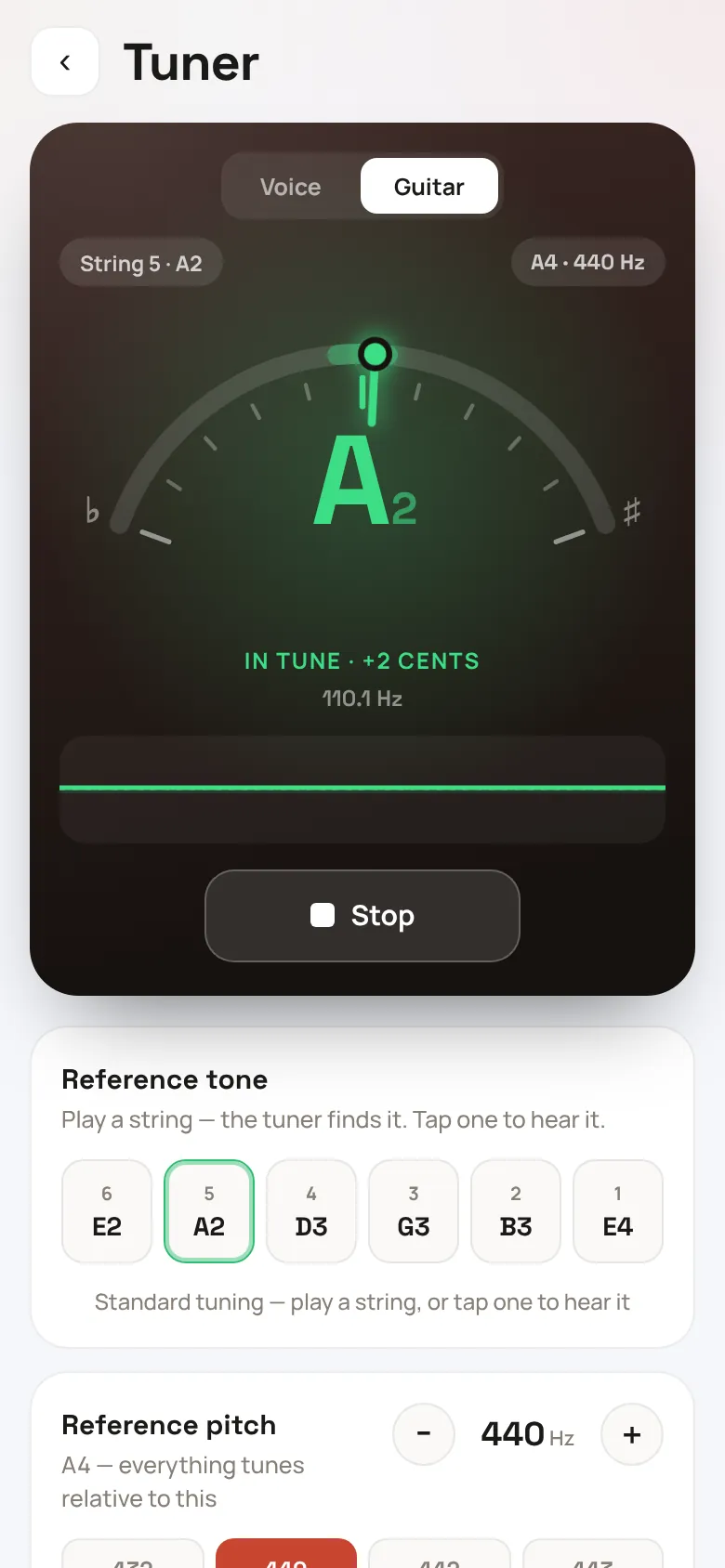
How to tune a guitar
- Start with the thickest string, the low E (string 6), and work across to the thinnest, the high E (string 1).
- Pluck one string and let it ring. Mute the others with your palm, so only one string sounds.
- Read the dial. Left of the middle means flat, too low: tighten the peg. Right means sharp, too high: loosen it. Turn a little at a time.
- Tune up to the note. If you went past it, drop below and come back up. The string holds its pitch better that way.
- Tune by ear too. Tick “Steady tone”, tap a string and its reference note keeps sounding: turn the peg until your string and the tone stop beating against each other. The dial shows the pitch you play in Hz as well as in cents.
- Check all six again. Tightening one string pulls the neck a little and nudges the others, so a second pass is normal.
Standard tuning: notes and frequencies
From the thickest string to the thinnest, standard tuning is E A D G B E. These are the exact pitches the tuner aims for with the reference A4 at 440 Hz:
| String | Note | Frequency |
|---|---|---|
| 6 | E2 | 82.41 Hz |
| 5 | A2 | 110.00 Hz |
| 4 | D3 | 146.83 Hz |
| 3 | G3 | 196.00 Hz |
| 2 | B3 | 246.94 Hz |
| 1 | E4 | 329.63 Hz |
Tap a string in the tuner to hear its note, if you want to tune by ear.
Other tunings
- Drop D (D A D G B E): only the low string goes down a whole step. Power chords on the bottom three strings become one finger.
- Half step down (E♭ A♭ D♭ G♭ B♭ E♭): every string a semitone lower. Common in rock, and kinder to a singer’s top notes.
- Open G (D G D G B D): the open strings ring a G major chord. Made for slide and blues.
- DADGAD: an open, droning sound used a lot in folk and Celtic music.
Choose one from the tuner’s menu and it measures each string against that tuning.
Why a guitar goes out of tune
New strings keep stretching for the first days, so they need tuning often. Temperature and humidity move the wood and the strings, which is why a guitar brought in from the cold drifts. Hard strumming and string bends pull strings out too. Tune every time you pick the guitar up: it takes a minute, and practising on a guitar that is in tune trains your ear on the right notes.
What “in tune” means here
Pitch is measured in cents, hundredths of a semitone. This tuner calls a string in tune within ±4 cents, the same band as the guitar tuner in the app. Right after a pluck a string sounds slightly sharp, so the tuner follows the attack and then settles on the note.
Playing with a piano or a recording that is not at A4 = 440 Hz? Move the reference between 430 and 450 Hz and tune to it.
Practise with the metronome
- Start slow enough to play it clean. Speed comes from clean repetitions, not from rushing.
- Then go up a few BPM once it is clean several times in a row.
- Tap tempo finds the speed of a song: tap along four or five times.
- Accent beat 1 so you always hear where the bar starts. Three beats for a waltz, four for most pop and rock.
Tuned up. Now learn to play.
Voiceturi’s guitar course goes from the names of the strings to chords, strumming, riffs and fingerstyle. Every lesson has a fretboard and tablature that light up as each note plays, a play-along at your tempo and a short video, and the first lessons are free. See the guitar lessons.
How it works
Press Start
Allow the microphone. The sound is analysed on your device and never uploaded.
Pluck one string
The tuner finds which string it is and how far off it is, in cents.
Turn the peg
Too low: tighten. Too high: loosen. Stop when the dot turns green.
Questions
Is this guitar tuner free?
Yes. It runs in your browser on a phone, tablet or computer, with no account and no download.
Does it work for acoustic, classical and electric guitars?
Yes, it listens through the microphone. An electric guitar is quiet unplugged, so play it close to the microphone or through an amp.
Why does the reading jump around?
Usually because more than one string is ringing, or because of noise in the room. Mute the strings you are not tuning, pluck once and let the note ring.
What does A4 = 440 Hz mean?
It is the reference pitch almost all music is tuned to. Change it only to match an instrument you cannot retune, such as a piano.
Is my sound recorded?
No. The pitch is worked out on your device while you play, and the sound is thrown away. Nothing is uploaded.
Is there a tuner in the app as well?
Yes, with a guitar mode and a voice mode, next to the guitar course, a metronome and ear training.