 Voiceturi
Play the guitar
right in your browser.
Pick a chord and strum it, or tap the frets one at a time. Every note shows its name on the neck, and the page tells you which chord you are holding.
- Runs in your browser
- No account needed
- Mic audio stays on your device
Guitar fretboard
The chord shapes are for standard tuning. In this tuning, tap the frets to build your own.
Computer keys: 1 to 6 pluck the strings from the lowest, Space strums down, Shift + Space strums up, and the letters on the chord buttons pick a chord.
How to play it
- Tap a fret to put a finger there: the string sounds and the note’s name appears. Tap the same fret again to lift the finger.
- Tap left of the nut (the thick bar) to switch a string between open (○) and not played (✕).
- Pick a chord from the buttons and its shape appears on the neck.
- Strum by dragging a finger or the mouse up or down across the strings in the Strum area, or with the two strum buttons.
- With a computer keyboard, keys 1 to 6 pluck the strings from the lowest, Space strums down and Shift + Space strums up. Each chord button shows the letter that picks it.
- With a MIDI keyboard, press “Connect a MIDI keyboard”. Each note you play sounds in the guitar sound and lights every place it lies on the neck. It needs Chrome, Edge or Opera on a computer or an Android phone.
- Left-handed turns the neck round, with the strum area on the left.
The notes on the guitar neck
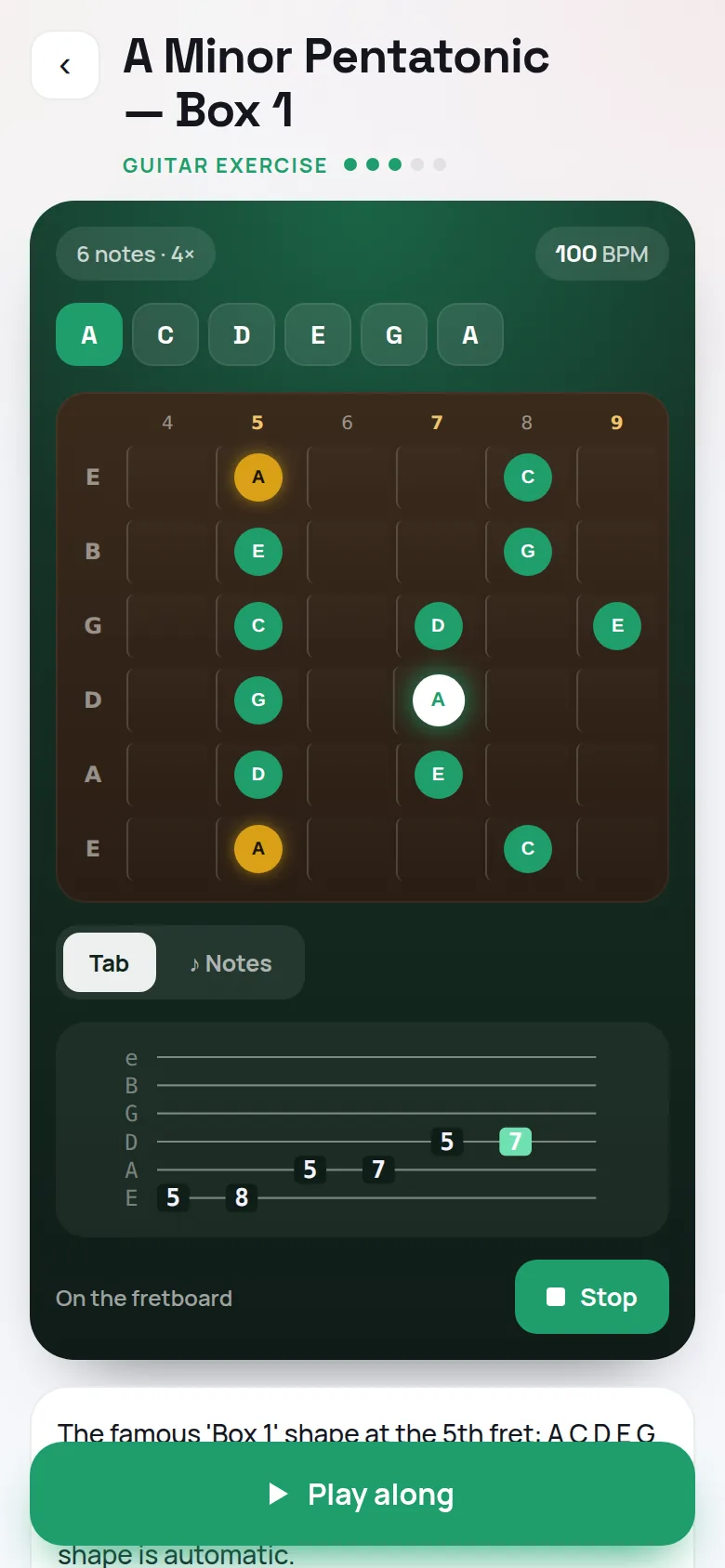
In standard tuning the open strings are E A D G B E, from the thickest to the thinnest. Each fret raises a string by one semitone, so the 12th fret is the open note an octave higher, and the dots on frets 3, 5, 7, 9 and 12 help you count. On the low E string the natural notes sit at frets 0, 1, 3, 5, 7, 8, 10 and 12: E F G A B C D E.
Turn on Note names and tap along one string to hear and see this. The same note is in several places on the neck: connect a MIDI keyboard, play one note and all of them light up.
Sixteen chords to start with
The buttons hold the open chords most songs are built from: C, D, E, F, G, A, the minor chords Am, Bm, Dm, Em, the sevenths A7, B7, D7, E7, G7 and Cmaj7. F and Bm are barre chords, where one finger presses several strings at once: they are the hardest, so leave them for later.
- Start with Em and Am: two fingers and three, next to each other.
- Then C, G and D. With those five you can play a great many songs.
- Change between two chords slowly, without strumming, until your fingers find the shape on their own. Then add a strum on each beat.
Tunings
The tuning menu has standard, Drop D, half a step down, open G and DADGAD, the same list as the guitar tuner. The neck follows the tuning, so every fret shows its real note. The chord buttons are standard-tuning shapes, so in the other tunings you build the chords yourself by tapping the frets; the page still names what you are holding.
Three sounds
Nylon guitar, steel guitar and electric guitar are recordings of real instruments, the same samples the Voiceturi guitar lessons use. They load as you play, so the first notes can take a moment on a slow connection.
From the screen to a real guitar
The Voiceturi guitar course goes from the names of the strings to first chords, strumming, the pentatonic scale and first riffs, with tab and a fretboard that light up as each note plays. The first lessons are free. See the guitar lessons · Guitar tuner.
How it works
Pick a chord
Or tap the frets yourself.
Strum it
Drag across the strings, or press Space.
Read the neck
Every note shows its name, and the page names the chord.
Questions
Is this online guitar free?
Yes. It runs in your browser on a phone, tablet or computer, with no account and no download.
Can I play it with my computer keyboard?
Yes. Keys 1 to 6 pluck the strings from the lowest, Space strums down, Shift + Space strums up, and the letter on each chord button picks that chord.
Does it work on a phone?
Yes. Tap the frets and drag your finger across the strings in the Strum area. On a narrow screen the neck scrolls sideways to reach the higher frets.
Does it sound like a real guitar?
The three sounds are recordings of real nylon, steel and electric guitars, the same samples the Voiceturi lessons use.
Can I use it to learn the notes on the neck?
Yes. Turn on Note names and every fret you tap shows its note. With a MIDI keyboard, each note you play lights every place it lies on the neck.
Is anything recorded?
No. The page plays sound; it does not listen. It never asks for your microphone, and it asks for MIDI only when you press the button.