 Voiceturi
Sing higher
without straining.
High notes are not about pushing harder. They come from going lighter as you rise, and from closing the gap between your chest voice and your head voice.
- Runs in your browser
- No account needed
- Mic audio stays on your device
Why the voice cracks
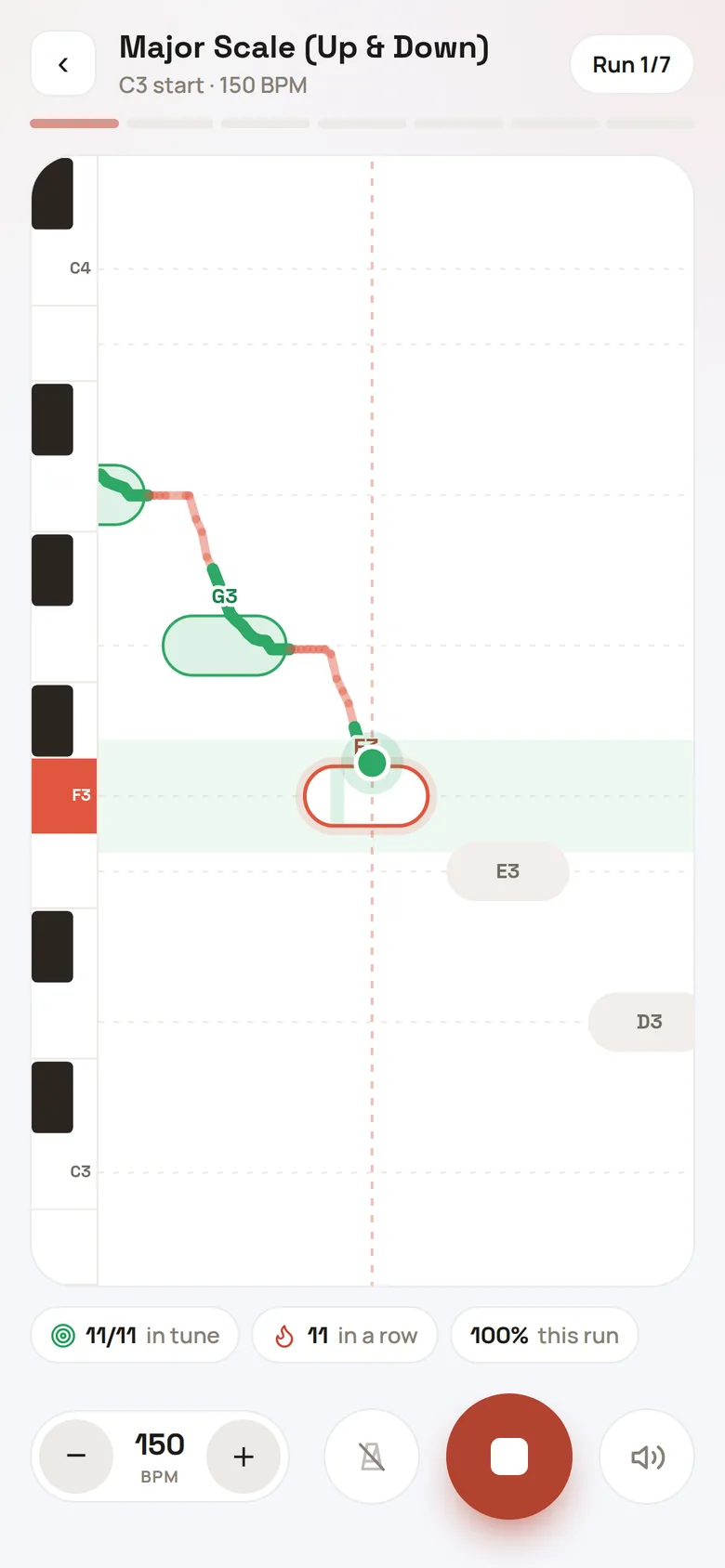
Somewhere in the middle of your range your voice changes gear, from chest voice to head voice. Carry too much chest weight up past that point and it flips: the crack. The fix is the opposite of what feels natural: get lighter, not louder, as you approach the break.
Exercises that extend your range
- Lip trills and humming. Semi-occluded sounds balance the air pressure, so the voice can pass the break without a jolt.
- Sirens. A slow glide from bottom to top and back, on “ng” or “oo”. Smooth is the goal, not high.
- Narrow vowels. “oo” and “ee” pass the break more easily than a wide “ah”.
- Top-down glides. Starting high and light and sliding down brings head voice into the middle, where the join is.
Voiceturi’s The Break pack works through exactly these, in ten levels, until the join stops being audible. The Agility & Range exercises then stretch the top step by step.
Rules that keep your voice safe
- Never push through the break. If it hurts or scratches, stop.
- Warm up first, and keep the sessions short: ten minutes a day beats an hour once a week.
- Measure, don’t guess. Re-take the range test every few weeks.
How it works
Measure your range
Test My Voice shows your lowest and highest note.
Smooth the break
The Break: lip trills, sirens and narrow vowels, level by level.
Stretch the top
Agility & Range exercises, placed in your voice type’s range.
Questions
How long does it take to sing higher?
It differs from voice to voice. The break usually smooths out before the top gets higher, and both need regular, short practice rather than long sessions.
Is belting bad for the voice?
Belting is a skill of its own. The app’s Twang & Cry pack trains the twang that makes a voice loud without pushing. If anything hurts, stop.
Is it free?
It is free to start, with no account. A third of every pack is free to play.
Is my voice recorded?
No. The pitch is worked out on your device and the sound is thrown away.